
Saturated Fat - is it all bad? Part 2. What is Saturated Fat?
Following my wife having blown or even discovered a gaping hole in my model I started to ask some questions, some fairly simple questions that turned out not to have simple answers. The first one I think we hit is “what types of fat do foods contain”
Unsurprisingly, the answer is saturated fat and unsaturated fat. So what does this actually mean, did one get very wet? For those of you without a chemistry degree I’ll try to explain.
The fat in our food is generally packaged up into triglycerides. A triglyceride is a molecule that has a glycerol backbone with 3 fatty tails attached – yes 3 tails, a very odd creature indeed. The three tails can be all saturated fay acids, all unsaturated fatty acids or a mixture of the two.
These fats are called fatty acids, so unsaturated fatty acid or saturated fatty acid. Being saturated really just means it is fully saturated with hydrogen atoms, but let’s not worry too much about the chemistry of that, we could go really deep.
The unsaturated fat family is a category itself and they can be monounsaturated or polyunsaturated. More about that later.
I’d heard of these terms before and kind of had the feeling they were good for me, but the one I was really interested in was saturated fat. I’ll talk about that now but as you will find out we cannot talk about them in isolation from unsaturated fat. After all nature never works in isolation!
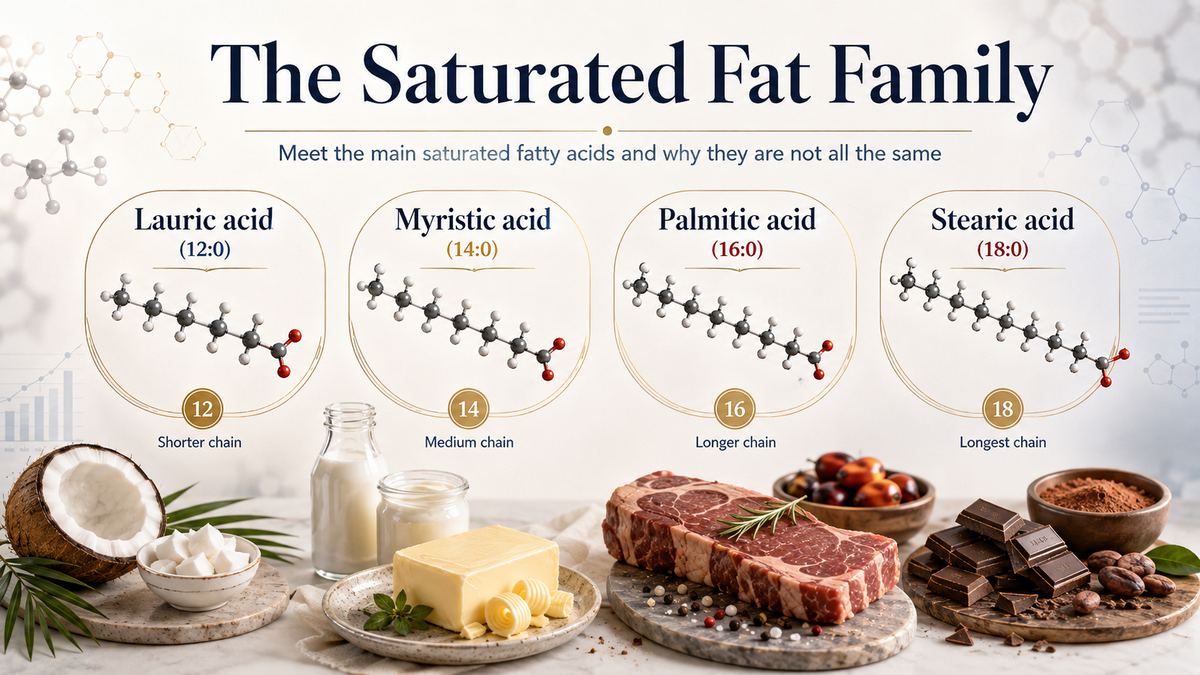
So it turns out that ‘saturated fat ‘ isn’t just one substance at all, it’s a family of different saturated acids.
The most common saturated fatty acids found in foods, and essentially our main characters in this investigation are:
Lauric acid
Myristic acid
Palmitic acid
Stearic acid
So when you look on the food label and it says 3g saturated fat per 100g, what you are not being told is which of the above it is. How much of it is Lauric acid, Myristic, Palmitic Stearic? This, as it turns out, matters. Quite a lot. Because 3g of one saturated fatty acid does not necessarily have the same effect as 3g of another.
Further Reading / Sources
HEART UK: Dietary fat recommendations
A useful overview of the different types of dietary fat, including lauric, myristic, palmitic and stearic acids and their differing effects on cholesterol.
USDA FoodData Central: Foundation Foods
A useful place to explore what individual foods are actually made from, including individual fatty acids such as 12:0, 14:0, 16:0 and 18:0.
Mensink et al.: Meta-analysis of 60 controlled feeding trials
A detailed scientific analysis looking at what happens to LDL, HDL and other blood lipids when different fatty acids replace one another in the diet.