
Saturated Fat - Is it all bad? Part 6 - Saturated Fat and increased LDL
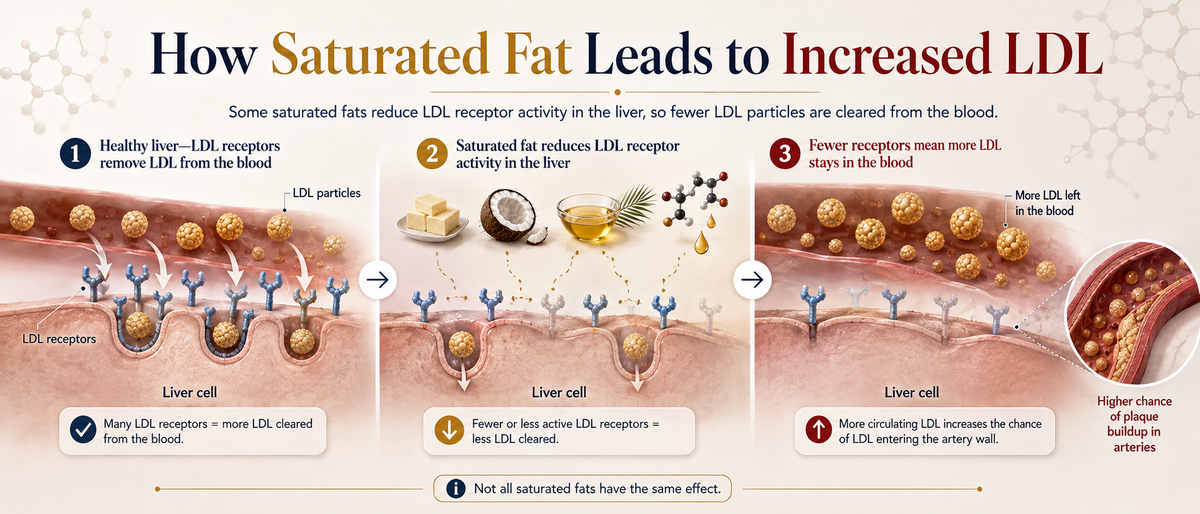
You will recall that the higher the number of LDL particles in the bloodstream, the higher the likelihood they will end up trapped in the artery wall. We also discussed how LDL receptors in the liver collect LDL particles in the bloodstream. Well one of the core parts to this process is a reduction in activity or the number of LDL receptors in the liver and this is where Saturated fats come into play.
Saturated fats can interact with the liver and reduce the number of LDL receptors available to clear up LDL particles in the blood stream. With a reduction in the process, LDLs are left to accumulate and increase the chance of some eventually ending up in the artery wall.
But not all Saturated fats have the same impact!
Myristic and Palmitic fatty acids
These impact the number of LDL receptors, thus increasing LDL particles.
Found in Palm oil, Coconut oil, Milk, Butter. Cheese, Cream, Pork
Lauric fatty acid
Again, reduce the number of LDL receptors but can increase HDL (the good cholesterol) which can have an impact on the overall effect.
Found in Coconut oil
Stearic fatty acid
Much of stearic acid is converted in the liver to oleic acid, which is a monounsaturated fat (more on these good guys later)
Found in Cocoa butter, Beef fat / tallow
I’ve given examples of which foods are high in the above fatty acids, but its important to remember that any food can contain more than one type of fatty acid. They key point here is that different types have different impact, resulting in different outcomes.
The good fats – monounsaturated and polyunsaturated
We won’t go into the detail here but both monounsatureated and polyunsaturared fats can increase the activity of LDL receptors in the liver, helping sweep up more LDL particles.
Types of monounsaturated fat include:
Olive oil, rapeseed oil, avocado oil and high-oleic sunflower oil
Avocados, olives and many tree nuts
And polyunsaturated (omega 3 and 6)
Many vegetable oils including sunflower oil
Oily fish, Walnuts, Seeds
I appreciate this doesn’t give you much to go on so we will cover some popular foods and go through typical quantities of fats next.
Further Reading / Sources
HEART UK: Dietary fat
Covers which saturated fatty acids raise LDL and why stearic acid behaves differently.
Saturated fatty acids and LDL receptor modulation
This is particularly relevant to the liver-receptor explanation. It discusses reduced LDL clearance and LDL-receptor activity as mechanisms by which saturated fat can raise circulating LDL.
Mensink et al. controlled-feeding meta-analysis
This gives the measured effects of different fatty acids rather than just explaining the mechanism.