
Saturated Fat - Is it all bad? Part 7 - Foods and Conclusion
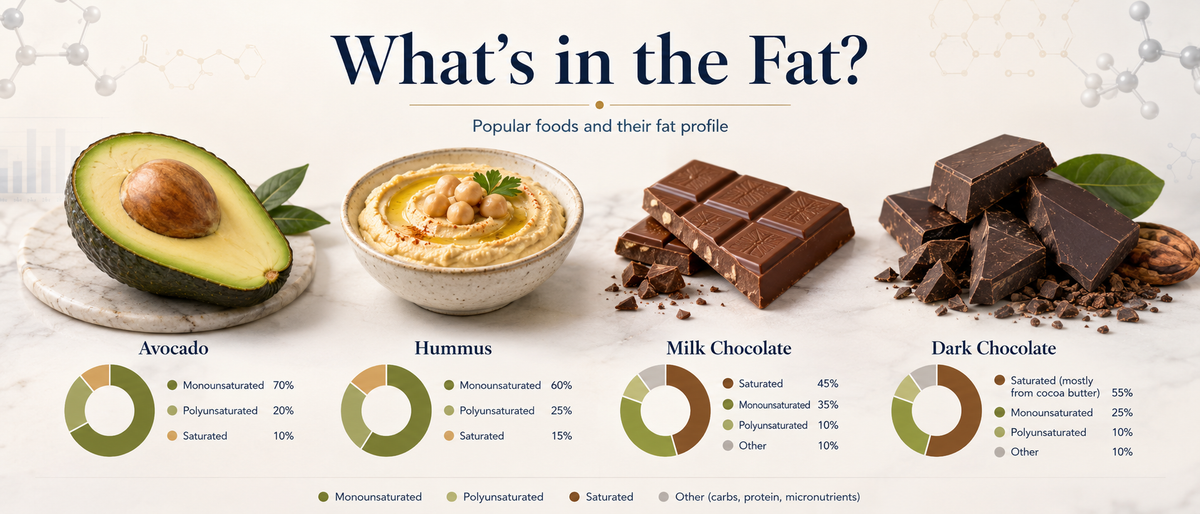
I’m going to go through some popular foods that give examples of the composition of fats that will hopefully help you make better decisions. We won’t cover the carbohydrate or protein content here.
Avocado (100g)
Total Fat: 14.7g
Monounsaturated: 9.8g
Polyunsaturated: 1.8g
Saturated: 2.1g
So in avocado we have a relatively high fat content but its mainly (79%) unsaturated fat. The saturated fat type is mainly Palmitic acid which you may recall is one of the more LDL raising types, however, the ratio of unsaturated fat to saturated fat is in our favour and makes this a healthy addition to our diet.
Dairy Milk (100g)
Total Fat: 30g
Saturated: 18g
Unsaturated: 12g
Dairy milk is the opposite, 60% of the fat is saturated. Looking at the ingredients, we have milk fat, cocoa butter and palm and shea fats, so multiple types of saturated fat, however the balance between saturated fat and unsaturated fat is heavily in favour of saturated fat so best to avoid if we are trying to reduce LDL.
Dark Chocolate (100g)
Total Fat: 50g
Saturated: 30g
Unsaturated: 20g
Again, by the label this looks terrible, however, much of the fat comes from cocoa butter which as we know contains large amounts of stearic acid and stearic acid has a smaller effect on LDL receptors than the other main saturated fats. It’s a good example of where saturated fat quantity doesn’t tell the whole story. So, dark isn’t quite as bad as the 30g saturated fat figure would have you believe, but not too much!
Hummus (100g)
Total Fat: 17.8g
Monounsaturated: 5.3g
Polyunsaturated: 8.8g
Saturated: 2.6g
Only about 15% of this is saturated and even some of that is Stearic acid, so overall a favourable fat profile.
Lentil Crisps
Total Fat: 18g
Saturated: 1.5g
Unsaturated: 16.5g
So this is a crisp, and only around 8% of the fat is saturated so from a fat perspective this food is ok, remember, we are only looking at fat here, not salt or calories!
So you can see, if we were to just consider total fat it would not represent the full picture and in fact we would probably be inclined to miss out on the unsaturated fats that help us, even looking at saturated fat content alone doesn’t give us the full picture. We need to understand what the ratio of saturated to unsaturated is and then if saturated fat is high then taking a look at what is providing the saturated fat content, is it coming from fats such as palm oil or butter for example which is not helpful to our LDL reduction efforts or is it cocoa butter which contains large amounts of stearic acid?
Its not quite as simple as one number on a label!
Conclusion
So this is all good but how do I make decisions? Well, going back to the start the daily saturated fat guidance is no more than 10% of your calorific intake (food energy) should come from saturated fat. So if your daily intake is 2000 calories then no more than 200 should come from saturated fat. This equates to around 22g of saturated fat daily. As I mentioned I target around 15g daily just because I’m trying to get mine down.
But as we have seen, not every gram of saturated fat is equal. The way I tend to work this is as follows:
Whole foods, eg avocado, olives, olive oil, that has a high fat content but a good ratio of saturated to unsaturated, ie 1:3. Then I won’t worry too much about the saturated fat content or logging it. I certainly don’t want to restrict this type of food.
Processed foods that have a good ratio, at least 1:3, I will consume but log the amount of fat. I will check the label for preferable fats, usually sunflower, rapeseed or avocado oil.
Processed foods that have a poor ratio, less that 1:3, I will generally avoid unless the majority of saturated fat is cocoa butter based, and then I will still record the fat.
To be clear about ratios, what I mean is that if there is 1g of saturated fat then there must be at least 3g of unsaturated fat. I’ll add that this isn’t official guidance its my approach to dealing with managed saturated fat and ultimately my LDL.
Further Reading / Sources
NHS saturated-fat guidance
Useful for readers who simply want established practical dietary advice.
Explore the actual food data — USDA FoodData Central
USDA provides individual fatty acids in grams per 100 g and explains exactly how those values are measured and reported.
WHO saturated-fat guideline
Specifically recommends keeping saturated fat below 10% of energy and replacing it with unsaturated fats rather than just cutting fat indiscriminately.